Motto Nuga-Cel! review

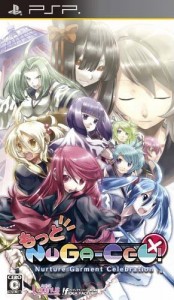
Months of playing games like Dragon Quest 9, Tactics Layer and Ar Tonelico have created in me a not-so-secret fancy for dressing-up games, so where else to go next but to the PSP remake of the classic “Grand Daddy of them All?” Motto Nuga-Cel! goes way further than any of the games mentioned above, with an entire battle system based around dressing, stripping and being stripped. Gotta give credit to Idea Factory: they’ve got ideas all right!

I don’t quite know where to start with this review, so I’ll play it by the book.

Story

The 23 districts of Tokyo-23 are at war with each other. As the master of Minato District, you and your girls have to conquer the other 22 districts while searching for three legendary artifacts that will supposedly make you the ruler of the world. That is basically all the story you are ever going to get.

Characters

A total of seven playable girls to control, dress up and woo. As a very deliberate policy, no males show up in the game, not even as pictures. There’s also a cast of baddies and assorted mooks, monsters and maids, mostly shallow and mostly there just for comedy/fan-service.

Graphics

Terrible. The character designs range from “okay” to “worst I’ve ever seen”. So this is why the art in Tactics Layer was so bad. It was a tribute to Nuga-Cel, huh? The occasional CG you can get range from “Hmm, okay” to “WTF AM I LOOKING AT” in quality. The quantity of fanservice is pretty high, since the game was explicitly made to appeal to male players. A case in point:

Gameplay

Oh boy, where to start. *deep breath* Okay, clothes. You have your base stats and two weapons per girl, but everything else depends entirely on the clothes you dress your characters in. Enemy attacks weaken these clothes until they suddenly pop off entirely, reducing your stats to nearly nothing. Lose your clothes and your girl is probably a goner. She will also squeal, cover herself and miss a turn out of sheer embarrassment, forcing you to spend the next turn putting more on (if she survives the next hit), so don’t count on her to be any use in battle. Since this happens to enemies as well, stripping is a key battle mechanic, vital for taking down enemies with high HP.
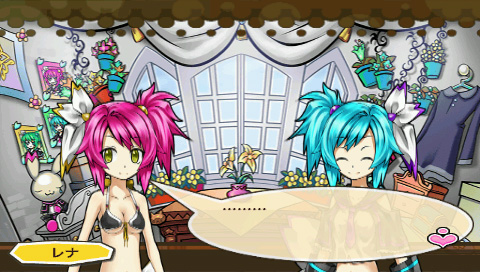
Characters will appear in cutscenes with the outfits you dress them in, no matter how ridiculous. If they get stripped, they’ll walk around in bras and panties until you put clothes on them again. Bosses you manage to strip will also ride out the next scene in their underwear.

Clothes can be bought from the store as the story progresses, but using them as-is is a terrible idea. It is vital to improve clothing stats by adding all kinds of patches and appliques to it. When I first started I had no idea how important this was, so I found the battles incredibly difficult. I kept trying to level up and to use battle items, but it was no use. My girls were stripped repeatedly while barely doing scratch damage to stronger enemies, and even the simplest-seeming battle turned into a life-and-death struggle.

After a few hours I cottoned on to the fact that it’s not about the clothes’ base stats, it’s about how “pimpable” they are, and everything took a turn for the better after that. Instead of craving new clothes, I craved new upgrades. Apart from patches, you can also update most outfits at  least once with special items. E.g. a modern swimsuit can be upgraded to an old-style school swimsuit. A maid outfit can be turned into a catgirl maid outfit, etc. The better the clothes, the higher the stat caps. If I had to give a single piece of advice to anyone who wanted to play this game it would be this: PIMP YOUR CLOTHES!

The stronger I got, the easier the game got. The easier the game got, the more fun things got. Instead of dreading battles, I looked forward to them. I couldn’t wait to attack new areas and continue the story. The final boss wasn’t a complete walkover, but he was still easy as pie compared to the earlier bosses when I didn’t know what I was doing. Motto Nuga-Cel falls in the “Easy if you know what you’re doing, otherwise hard as hell” category of games.
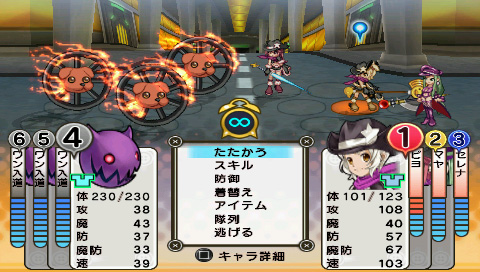
The flow of the game generally goes like this:

1. Conquer area. You can only attack areas that are adjacent to your territory. Each territory takes several battles to conquer, and while they won’t attack you until you attack them first, once you do they’ll retaliate with gusto.

2. Once area is conquered, build some kind of facility on it. This doesn’t apply to areas that have important landmarks on them (e.g. Shibuya and the Hachiko statue) but facilities give you money/items every day.

3. Invest in conquered area so you can get more tribute every day. Maximizing investment will take several days.

4. Explore dungeons underneath the area, if available. Territory fights involve humans, but dungeons are populated by all sorts of interesting monsters, including rocket-propelled pencils, militant baby chicks and the adorable flaming puppy heads pictured in the screenshot.

5. When you’re ready, attack the next area and repeat the process all over again. Areas are ranked by difficulty, from one star to five, so if you follow the rankings, take your time and, most importantly, upgrade your clothing, you shouldn’t find it too hard.

When you’re not fighting, you get the occasional opportunity to woo your party members. This is important partly because it raises their base stats a little and also because you get a specific ending for whichever girl who loves you best at the end. It was obviously thrown in there as an afterthought, and has no real bearing on the plot or story development.

Battle System
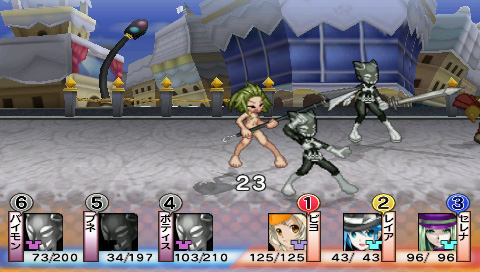
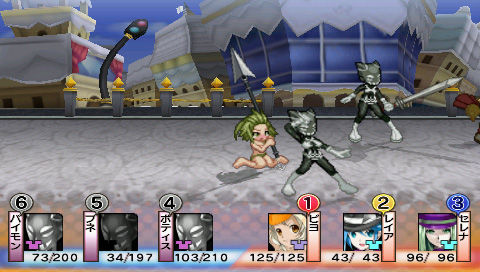
Standard turn-based RPG system, characters move based on speed. In fact Speed is probably the most important stat in this Strip or Be Stripped world. Speed, speed, speed! It doesn’t matter how strong you are, the longer the battle goes the more likely you are to end up naked! This is because any enemy attack that hits will do clothing damage even if it hits for 0. You want to dodge at all costs. Plus the lower your speed is, the less accurate your attacks will be and you absolutely cannot have that.

In addition to stats, clothes convey different skills to characters, which are used with MP (called “Tiredness” in this game). Most clothes come with innate skills as well, sometimes negative. For example the powerful animal suits have a “Trip” skill that causes you to miss turns frequently. NOT cool. As an extra note, HP, Tiredness and Clothing Strength do not recover immediately after battle. You either have to wait a few days or take them to healing facilities to be healed.

My battle party for most of the game was Maya, Piyo and Serena. I made a brief effort to raise the other girls as well, but this is one of the few RPGs where EXP does not scale, so it was an exercise in frustration. 50 exp from a level 10 monster is the same as 50 exp from a level 100 monster to all characters. Clothes make more difference than level anyway, so it’s better to have a few extra sets of maxed-out clothing for repeat battles than to have two full parties ready to go. You can also recruit extra party members, but I can’t for the life of me see any reason to do so.
Everything Else

I used the final save I had to get three different endings. The first was a standard ending with Maya where she tries to creep into your bed. Then I reloaded and made the “other” choice which resulted in a very interesting battle. I got two more endings by first losing then winning that battle. I can’t say much for the endings, though. They were…adequate. New Game Plus let me carry everything over except affection levels and conquered areas, which should make replays a breeze, but I’m not sure I want to replay this game. With no new story elements to uncover, easy battles and meh endings all around, Motto Nuga-Cel! is worth only one playthrough.

Saigo no Yakusoku no Monogatari – Finished!

I lost count of the number of hours I poured into Saigo no Yakusoku no Monogatari. About 25? Something like that. Most people seem to finish between 15-20 hours, so I really dragged things out. Instead of grinding to beat bosses I should have just used those overpowered SP attacks earlier. I was afraid of running out, though, and they came in really handy for the final boss and subsequent boss rush, so it all worked out.


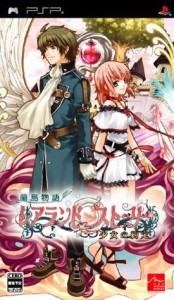
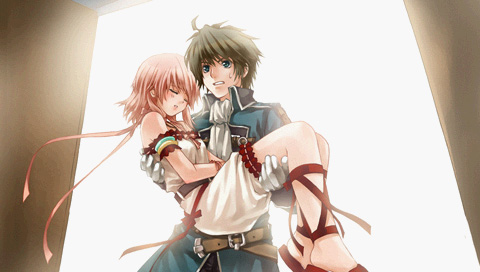
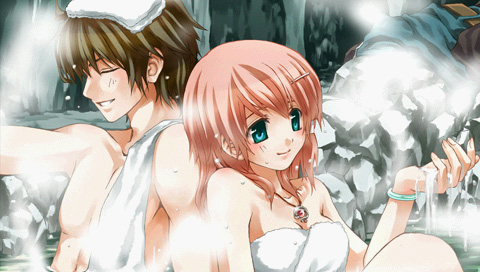
I got two ending CGs. First I got the one you get where every Messiah is alive, then I went back and killed Sasha off (told you I’d get her someday) so I could get the Rushdie CG you see on your right. If I’d had the stamina I would have tried to get a third ending, where I kill Rushdie off to see which CG they give me. Probably nothing, since I won’t qualify for any of them.

The ending is the same for all ‘routes’ as far as I can tell, it’s just the final CG displayed after the credits that differs depending on who you made your final promise with and who’s still alive at the end. The ending itself was okay, but really short. No surprises throughout the whole game. Around chapter 3 they said “This is the problem we’re having, and this is what we’re going to do about it.” Two chapters later they did it, everything went off without a hitch, roll credits. No unexpected events, no chance to do the wrong thing, no multiple solutions, just linear as the 5 o’clock express.

I was going to write a detailed, spoiler-ful post with my thoughts about Final Promise Story later on, but now I think of it, it doesn’t really deserve that kind of attention.  Plus I would have had to do a lot of reading up about the promotion of this game, and I don’t feel like getting involved in FPS any further.

Why reading up about the promotion? Because the crux of my problem with this game revolves around whether Imageepoch accurately represented Final Promise Story as a pure dungeon crawler and not as a full-fledged RPG before it came out, or not. If it’s the former, then I have very little grounds for complaint. I’d end up whining about stuff like this:

– The characters were shallow and completely undeveloped, probably because they all know each other already and have nothing to discover over the course of 24 hours,

– character interaction was nearly non-existent. Because of the game’s anyone-can-die mechanic, no party members except Wolf and that girl can be intimately connected to the plot. This causes a disjoint because your relationship with the other Messiahs is supposed to be vital to the story, but the Messiahs themselves can’t be important lest they die so, wtf? I’ll also note that Sasha didn’t get so much as an “Alas, poor Sasha” when she kicked the bucket,

– the plot never went anywhere (wtf was that incident a year ago they keep referring to? what is Sabi Chantier’s ultimate goal? how exactly did the war start? who’s the mastermind behind the whole attack? what’s to stop them from coming back with more machines? what happens after the end, aren’t they doomed anyway?) and leaves you with more questions than it answers,

– the mood of the music was off, it felt more like casual lounge music. More “Why yes, I’ll have another glass of champagne with my caviar” than “OSHIT OSHIT we’re all going to die,” and the music stays the same throughout the whole game even as the time gets shorter and shorter. Heck the mood of the whole game was off,

– the battles were repetitive, I just found one or two patterns that worked and used them forever on the same old palette swaps in the same old dungeons. I remember hearing that enemies would adapt to your battle strategy after a while but that’s a 1000% lie,

– goddammit, why do I have to do the same bloody crappy mission over and over again? Hundreds of hours of gameplay my bottom, it’s all the same damned mission worded differently! <— the strong language is because this is by far my biggest complaint about the game,

– having all your skills and attacks as well as the entire map revealed right from the start takes out all elements of surprise and excitement from the gameplay. Now I understand why randomized dungeons and treasure chests are so common in that genre,

etc etc, and these are all common features of dungeon crawlers. Not all of them and not all the time, but the weak plot, repetitive gameplay and underdeveloped characters occur pretty often. So if Imageepoch was clear about that from the start then I was expecting stuff the game was never intended to deliver, and thus I have no case whatsoever. I mean, my memory is telling me stuff about weekly character introductions and action-packed trailers worded in a way to make it seem like an ordinary jRPG, but I’m not as young as I used to be so maybe I imagined it. I freely admit I didn’t pay very close attention to the pre-game hype, to my lasting regret. In any case, I’d need to check all this out before writing anything definitive about Saigo no Yuckysucky no Monogatari, and I really don’t want have anything more to do with this game.

Long story short, Final Promise Story is a short dungeon crawler in which absolutely nothing happens. It’s got pretty graphics, decent character designs and nice, relaxing music. If you can accept that without asking for anything more, go for it and good luck. I’m out.

Games that just didn’t work out

I play a lot of games from start to finish. I play even more from start to whenever-I-get-tired-of-it. However every once in a while (…actually pretty darn often) there’s a game that I try to play only to give up very quickly for one reason or another. I usually don’t even mention them here firstly because I have nothing to say, and secondly because I have better games to write about, but I’ll list a few recent victims of this practice here.

Remindelight (DS) – Long intro, cliched story about rescuing sister from forces of evil, meh graphics, massively squashed-up text that’s incredibly difficult to read, terrible battle system that consists of slashing randomly at the screen, etc. I don’t think I got even an hour into this one.

Houkago Shounen (DS) – One of the games you have to be Japanese to appreciate, I guess. It follows the life of a little boy in 80s Japan as he goes to school, comes home, plays with his friends and tries to avoid moving away with his family at the end of summer. It was heartwarming but, frankly, extremely dull, and none of the mini-games he plays seemed like any fun. Instead of me playing a game about him, he needs to play the game about my childhood.

Astonishia Story (PSP) – I played about an hour last week, and it reminded me of Tactical Guild in terms of sheer terribleness. Even the samey-looking bad guys, walk-up-and-attack battle system, forced humor and paper-thin characters are similar. I could grow to love this game, I know I could. But I’ve already played one so-bad-its-good game this year, so AS will have to wait till at least 2012 to get its turn. If ever.

Inugami DS, Allison & Lillia DS – Not games, just books put on the DS by publishers out to make a few extra bucks. I thought reading light novels on the DS might be more fun than reading scanned copies on the screen (Buy? what is this “Buy” you speak of?), but this probably only applies to books that are worth reading in the first place, i.e. NOT Inugami.

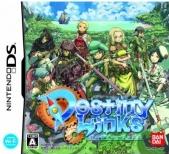
Destiny Links (DS) – Shame, it’s a really promising game. Destiny Links had lots of elements I love in an RPG (quests, item crafting, world exploration, multiple character scenarios to play through), but I just couldn’t get past the pure action RPG battle system. I can handle ARPGs with level ups because then I can just grind till I’m strong enough, but systems that require me to actually show some skill and dexterity are a no-go. I managed to finish the first island, then threw my hands up after that. The tiny characters and the mostly-hiragana text didn’t help either.

Mimana Iyar Chronicle (PSP) – Plays like Tales of the Tempest, feels like a Grandia II rip-off. If I had a dollar for every grumpy mercenary with a chip on his shoulder… I made it to the first boss, who promptly wiped me out. Now I either have to grind or actually get the hang of the battle system,  neither of which appeals to me right now. Dumped until further notice.

The World Ends With You (DS) – I’m giving it my best shot, I really am, but… It’s not doing anything for me. I’m just getting more and more stressed by the moment. Not only is the “story” not going anywhere I care to follow but also the battle system is all over the place. Which part of this is supposed to be fun? If it’s the 7-day Lockdown in Tokyo thing, I already did that in Devil Survivor, thank you. And can I get another couple of dollars in here for the “Everybody just leave me alone” protagonist? I haven’t thrown in the towel yet, but…

Hoshigami Remix (DS) – From the makers of my beloved Stella Deus, but this one is a wash. The battle screens make me claustrophic and the battle pace is downright catatonic. The characters on the screen are tiny (I complain about tiny characters because I have bad eyes, true story), the character designs are fuzzy and awful, the story is boring, the music is unremarkable, etc. Basically everything that can be wrong with a game is wrong with Hoshigami Remix. But I like SRPGs enough that I’ll probably play it on and off for a while to come. I especially like the Tower of Trial being unlocked right at the beginning. Maybe I’ll even finish it, eventually.

Harvest Moon Boy & Girl + Hero of Leaf Valley (PSP) – I shouldn’t have to repeat how much I love Harvest Moon games, but both original versions on the PS2 were a bit of a failure for me (I liked Innocent Life though, for some strange reason). I don’t know what I expected from the PSP remakes, but what I got was a whole lot of nothing. Hero of Leaf Valley seems to have a bit of potential – I did play quite a bit of Save the Homeland – but Boy & Girl is definitely out.

Breath – Toiki wa Akaneiro (DS) – I probably haven’t mentioned this before, but I don’t really like visual novels. Every couple of months I give one a shot just to see what’s going on, but it never works out. Breath would have been bad enough on its own, but the existence of several stupidly irritating games that force you to blow into the DS mic repeatedly was the last straw.

Hiiro no Kakera (DS) – Like I said, I don’t like visual novels. I gave this a shot because it’s one of the few otome ‘games’ for the DS, but I sorely regretted it. None of the male character designs appealed to me. The main character was whiny, ungrateful, stubborn, bitchy and mean. My dream was to lead her to a painful, ugly death, but I quit long before I got the chance. The story seemed to have potential, but every single scene, no matter how petty, dragged on for ages and ages so I gave up. This is a feature of all visual novels, btw, which is part of the reason why I don’t like them.

Berwick Saga: Tear Ring Saga series (PS2) – Gave up right in the middle of the first mission. I love SRPGs, but the hexagonal model was too confusing and the battles were hard. It would probably have turned out well if I’d pushed through to the end, but it came at a time when I was up to my nose in other SRPGs, so it just couldn’t compare. I looked around to see if it had gotten stellar reviews or anything, but “meh” seemed to be the general response so I dumped it.

Legend of Heroes I & II (PSP) – Nothing wrong with them, they’re just boring. I should have played them 15 years ago along with BoFII and Lufia I, then they’d have fit right in. I tried both LoH I & II in turn, but I think I’m going to have to save them for when I’ve run out of other PSP RPGs to play. Gotta say, I love Falcom’s character designs though.

Now back to the stuff that is working out. I really need to get off my butt and just finish Saigo no Yakusoku no Monogatari and three or four other games I’m almost done with but never got round to posting about.

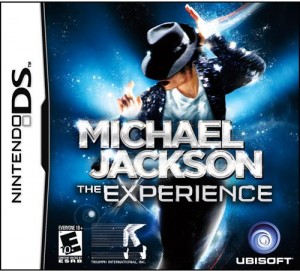
Michael Jackson – The Bad Experience

And by “Bad” I mean it sucks. I have no idea how they managed to mess up the winning formula of Michael Jackson music + Ouendan/EBA gameplay, but they did.

I’ve had Michael Jackson: The Experience since Christmas, but I’m such a Michael Jackson fan I decided to wait for a “special” day to start it. I settled on either his birthday or the anniversary of his death. So June 25th 2011 rolled around. I pulled out my DS. I put on a brand new screen protector and dug out a new stylus just for the occasion. I started to play.
1 hour later… M-maybe it gets better…y-yeah…

3 hours later … WHAT IS THIS FAGGOTRY?!

What could possibly have gone wrong? Plenty. At first my disappointment was so strong I wasn’t even going to write this review, but since I technically did “finish” this game, I suppose I can jot down a few points, to serve as a warning to future generations.

What didn’t suck

– Full original versions instead of covers.

– Music quality was great, even though crappy DS speakers.

– Images were bright and colorful.

What sucked, i.e. Everything else

– Only 12 songs on only 3 difficulties.  Also while I don’t mind that there’s no Thriller, it doesn’t make sense to have a dance game and not include one of the most iconic dance sequences in history in it.

– Full versions of every song, including intros and outros, made each stage drag on interminably. I’d have preferred the full versions to be unlockable and the playable ones to be shorter.

– Game consists of a hideous, expressionless MJ bobblehead executing some fairly well-done but highly cartoony dance moves. The only thing is, calling MJ’s dancing “fairly well-done” is like calling the Grand Canyon “fairly wide.” Ubisoft didn’t make even the weakest of efforts to capture the crispness and fluidity that was Michael at his best and the result is that The Experience feels more like a parody than a tribute.

– No in-game reason for playing except “It’s Michael Jackson music.” I like a story, even if it’s incredibly flimsy. As it is, the selling point is supposed to be tapping along to MJ’s music. But I’ve danced, sung, screamed, eaten and slept to MJ’s music for decades (I’m not saying how many!!). A game with nothing else to offer me but a few rhythmic taps to the same songs I’ve owned for ages is, to be blunt, an utter waste of money.

– The gameplay is no fun at all. It’s supposed to play like Ouendan/EBA, but it’s not anywhere near as exciting. The taps/beats don’t go with the music half the time. Sometimes they go with the backing vocals, or bass beat, or drum beat, or goodness knows what beat. There are breaks inserted at random places. There’s no reward for accurate taps, but the penalty for inaccuracy is steep and painful. At the same time Michael keeps dancing whether you make a mistake or not, so it’s like the player might as well not be there. Even on Hard your life barely goes down even when you make a mistake, etc etc etc. Yet another case of “taking the form and missing the essence.”

– The rewards are silly. Just drawn memorabilia like the camera from “Billie Jean” and the anti-gravity shoes from “Smooth Criminal.” It wouldn’t even have been so bad if each item came with some trivia and details that fans would enjoy reading, but no, it’s just “Take this average drawing of a white glove, and be grateful we gave you that much.”

And so on and so forth. I “finished” it in half a day, and the music is the only thing I enjoyed about the whole experience. I gave it to my younger cousin last week, and he seems to be enjoying himself, so maybe I’m just not the target demographic? Then who is the target demographic if not lifelong fans? Nah, I stand by my initial assessment: Michael Jackson The Experience is a half-assed effort to make money off MJ fans before the grief wore off. Real smooth, Ubisoft. I’ll remember this.

Ranshima Monogatari – Rare Land Story (1)

No sooner had I seen Princess Maker 4 off than I moved right onto its replacement, Ranshima Monogatari – Rare Land Story. And I had an even better time than I did with PM4.

First, about the title: all the official material has the title as “Lair Land”, but since most English sites call it “Rare Land,” I’ll go with that. The important thing is, Ranshima Monogatari is essentially the same game as Princess Maker 4, with far better graphics, more interesting characters and quite a few innovations. As a matter of fact, Ranshima Monogatari appears to be a PSP remake of a 2007 Chinese PC game that was heavily inspired by the Princess Maker series.

The story has you as a baron named Hiro who finds a mysterious girl lying on a slab during a war. This girl uses the power of the pendant around her neck to stop the war (I think? she put out a few fires at least), then loses consciousness. The local priest jumps to the conclusion that the girl, Chilia, was sent by the Goddess to test humanity and asks Hiro to teach her about life. The way she grows up will affect the fate of mankind, etc etc.

Or so they said, but after I mastered the town cleanup job, I wound up with an ending where she becomes a town custodian and ends up splattered in sewage. Unless this is a subtle metaphor for the state of the human mind, I have to conclude that the priest had just been sampling the sacramental wine a little too heavily.

I already went into detail about the mechanics of this sort of raising sim in the Princess Maker 4 post, so there’s no need to go over it again here. It lasts four years (instead of 8 in PM4) , the jobs and stats are largely similar, and when Chilia’s tiredness gets too high, you can take her on vacation or give her breaks so she can recuperate. You can also visit stores and other locations in town to buy things, meet and woo other characters and unlock special events and CGs.

The ending you get depends on your relationship to other characters, Chilia’s stats, events witnessed, etc. Unlike in PM4, the main character (Hiro) has multiple individual endings separate from Chilia’s that can be viewed once the right conditions are met. You can get a double ending where Hiro marries Somarina and Chilia marries Douma, for example.

There are plenty of other differences as well, both big and small. I’ll list the most notable ones:

1. You can change Chilia’s hairstyle in addition to her clothes. And buy/gather material and have the dressmaker custom-make items for you. Clothes and hair affect stats and also affect the support of Chilia’s “fanclub”, who will give her items and money if they like her. Chilia’s hair also grows from year to year, so if you give her short or medium haircuts they’ll start to look kinda funny after a while.

2. You can buy new decorations and furnishings for your room. Additionally, devoting a sum of money to upkeep every month will slowly make it bigger and fancier, allowing you to add posher decorations. However if Chilia’s tension (motivation) gets too low or she’s otherwise unhappy she will blithely trash the place until you make her better (where’s a “Spank” option when you need one?).

3. Commands are entered twice a month in 5 day blocks. This means you can do up to 6 different activities a month instead of 3.

4. The graphics are way better than in PM4. The character designs are cuter as well, and there’s a little more variety in the NPC designs. I thought the girls were especially good-looking, but the guys were decent as well. I wish I could’ve gotten to see Guana’s real face. I bet she’s hot.

5. Apart from raising Chilia, you’re also tasked with rebuilding various parts of the city. It’s entirely optional, but it nets you various rewards as you progress and makes things up to 50% cheaper in town. It may also be a requirement for the best ending.

6. There are a few more animations for work and for school. You get different ones depending on whether you do poorly, well, very well or marvelously well. They also evolve as you get better at jobs. For example when you’re a cleaner you start out as a lowly street-sweeper, then you graduate to picking up cans. Or when you’re rebuilding the city, you go from gathering lumber to sawing planks, to nailing them together to laying bricks. It’s a lot more interesting to look at than the same old animations in PM4.

7. Chilia can engage in “research” into the creation of new items, which you can use, sell for a profit, contribute to the town or just add to your collection. Doing this can earn you “research points”, which probably go towards a particular ending but otherwise have no real use.

8. No battling, not even at festivals. You can sort-of send Chilia adventuring, but it’s luck-based (I think?) whether she’ll find anything or not. The rewards are mainly money anyway.

9. You can set seasonal targets that you want to meet when raising Chilia’s stats. If you manage to meet the target, you’ll get all kinds of bonuses ranging from money to bonus points to MP.

10. Bonus points and bonus cards can be used post-game to unlock things like new outfits and new skills before starting a new game. For example I got a card that let me start the game with 2000 extra eve (their currency). Very helpful. It’s just unfortunate that even though you can earn bonus points throughout the game, you can only spend them after finishing.

11. Skills exists, sort of like in Tokimeki Memorial 4 but not as complicated. They’re “purchased” with MP and can be either temporary (e.g. lower tiredness for 60 days) or permanent. MP can be obtained as bonuses for doing well or by praying. There’s no actual magic training in this game as far as I can tell.

12. Hiro has a little more personality than characters in his position normally do. Just a little more, he doesn’t really talk much, but he does interact with people independently of Chilia and he does show up in CGs from time to time. The independent interaction can be confusing though, because some events take place with only Chilia present, only Hiro present or both present, but the game doesn’t tell you which.

13. Flaw: The little skits and town events run for a long time and have tons of dialogue. Some of the events are funny and interesting, but even those ones drag out a little too long. I don’t like it when my sims get too visual-novelly. A little less dialogue and a lot more gameplay would have made this game a real gem.

14. Massive flaw: you can’t quick-load. “Maddening” doesn’t begin to describe that feeling when you make a mistake entering commands or you want to change an answer, and then you have to turn the game off entirely and reload the whole thing before you can make changes.

15. Massive flaw: You can’t skip events or fast-forward conversations except by tapping the O button, which doesn’t go that much faster. Chilia’s commands also take forever to play out, even on the fast automatic setting. Points #13-15 together make it highly unlikely that most players will have the stomach for more than a few playthroughs of Ranshima Monogatari, despite its otherwise very high quality.

So while it’s clearly based on the Princess Maker mechanic, Ranshima Monogatari contains enough differences that it doesn’t feel like a blatant copy.

Initially I was only going to play it once, but after I got the rather disappointing town custodian ending, I’ve been wanting to at least get a marriage ending for either Hiro or Chilia. However I have abandoned that quest after discovering that I’d have to follow a guide very closely in order to discover all the events and give correct answers to questions before I can get even a common street rat to marry me.

So I’ve decided to try for an ending where I rebuild the town to its former glory, just to see what it gets me. I’ll go out regularly and try to chat up some guys and girls too, but I’m not expecting anything from that. More on that if/when it happens.